Soup
Classic French Onion Soup
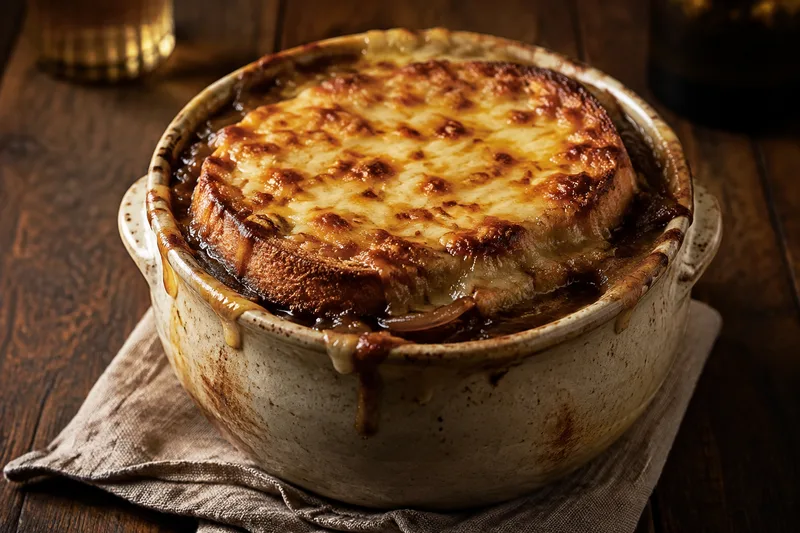
Deeply caramelized onions in a rich beef broth with white wine and dry sherry, finished beneath toasted baguette and a bubbling Gruyère crust.
- Prep
- 25 minutes
- Cook
- 2 hours
- Total
- 2 hours 35 minutes
- Yield
- About 10 cups
- Difficulty
- Moderate
Ingredients
Caramelized Onions
- 4 pounds yellow onions (Approximately 6 large onions, halved through the root and sliced 1/4 inch thick from pole to pole)
- 3 tablespoons unsalted butter
- 1 tablespoon olive oil
- 1 teaspoon kosher salt (For drawing moisture from the onions; season the finished soup separately)
- 3 cloves garlic (Finely minced)
- 2 tablespoons all-purpose flour
Soup
- 1 cup dry white wine (Such as Sauvignon Blanc or an unoaked Chardonnay)
- 1/4 cup dry sherry (Not cooking sherry)
- 8 cups unsalted beef stock (High-quality homemade or refrigerated stock strongly preferred)
- 2 cups unsalted chicken stock (Lightens the beef stock without weakening the soup)
- 2 bay leaves
- 6 fresh thyme sprigs (Tied together with kitchen twine if desired)
- 1 teaspoon Worcestershire sauce (Optional but recommended for additional savory depth)
- 1/2 teaspoon freshly ground black pepper (Plus more to taste)
- kosher salt (To taste only after the soup has simmered)
Gruyère Toasts
- 1 French baguette (Cut into twelve 1/2-inch-thick slices)
- 1 tablespoon olive oil (For brushing the bread)
- 12 ounces Gruyère cheese (Freshly grated, about 3 cups)
- 2 ounces Parmigiano-Reggiano cheese (Finely grated, optional)
Instructions
Caramelize the Onions
Melt the butter with 1 tablespoon olive oil in a wide, heavy-bottomed Dutch oven over medium heat. Add the sliced onions and 1 teaspoon kosher salt. Toss thoroughly to coat. The pot will be very full, but the onions will collapse as they release moisture.
Cover and cook for 15 minutes, stirring every 5 minutes, until the onions have softened and released a substantial amount of liquid. Remove the lid and reduce the heat to medium-low.
Continue cooking uncovered for 45–70 minutes, stirring every 5–8 minutes at first and increasingly often as the onions darken. Scrape the bottom and sides of the pot thoroughly each time.
When a brown film develops on the bottom, add 1–2 tablespoons of water and scrape it into the onions. Repeat as needed. Adjust the heat downward if the fond turns black or the onions begin sticking faster than they can be stirred.
The onions are ready when they have reduced dramatically and become uniformly deep mahogany brown, jammy and intensely sweet. Pale golden onions are not sufficiently caramelized. Expect the complete process to take approximately 60–85 minutes after the initial covered cooking.
Add the garlic and cook for 30 seconds. Sprinkle the flour over the onions and cook for 2 minutes, stirring constantly, until no dry flour remains.
Build and Simmer the Soup
Add the white wine and dry sherry. Increase the heat to medium and scrape every browned bit from the bottom of the pot. Simmer for 5–7 minutes, until the liquid has reduced by approximately half and no longer smells sharply alcoholic.
Add the beef stock, chicken stock, bay leaves, thyme, Worcestershire sauce and black pepper. Bring the soup to a gentle boil, then reduce the heat to maintain a steady uncovered simmer.
Simmer uncovered for 30–40 minutes, stirring occasionally, until the broth tastes unified and the onions are completely tender. Skim away excess fat or foam from the surface.
Remove the bay leaves and thyme sprigs. Taste the soup before adding any additional kosher salt because the stock, Worcestershire and cheese topping contribute seasoning. Adjust with salt, black pepper or a small splash of dry sherry if needed.
Prepare the Gruyère Toasts
While the soup simmers, heat the oven to 400°F. Arrange the baguette slices on a sheet pan and brush both sides lightly with olive oil.
Bake for 8–12 minutes, turning once, until dry, crisp and lightly golden. The bread must be well toasted so it does not immediately dissolve in the soup.
Assemble and Broil
Position an oven rack approximately 6 inches below the broiler and preheat the broiler. Place six broiler-safe soup crocks on a sturdy rimmed sheet pan. Confirm that the bowls are specifically rated for broiler use.
Ladle hot soup into each crock, leaving approximately 1/2 inch of space at the top. Float two toasted baguette slices on each serving.
Cover each crock generously with Gruyère, allowing some cheese to reach the edge of the bowl. Sprinkle with Parmigiano-Reggiano, if using.
Broil for 2–5 minutes, watching continuously, until the cheese is completely melted, bubbling and deeply browned in spots. Broilers vary considerably; do not leave the oven unattended.
Remove the sheet pan carefully and let the crocks stand for 5 minutes before serving. The bowls and soup will remain dangerously hot. Serve each crock on a heatproof underplate and warn diners not to touch the bowl.
Notes
The defining step in French onion soup is properly caramelizing the onions. This cannot be rushed. The onions should be deep mahogany, not merely soft or golden, before the wine and stock are added. Four pounds of raw onions will reduce to a surprisingly small, intensely flavored mass.
Slice the onions from pole to pole rather than across the equator. This follows their natural fibers and helps them retain enough structure during the long cooking process. Slices approximately 1/4 inch thick caramelize evenly without disappearing into paste.
No sugar is needed. Patient cooking develops the onions' natural sweetness. Small additions of water help dissolve the browned fond and prevent scorching without interrupting caramelization.
The soup is only as good as its stock. Use unsalted homemade stock or high-quality refrigerated stock whenever possible. Many shelf-stable beef broths taste metallic or excessively salty after simmering.
The chicken stock softens the sometimes heavy flavor of all-beef stock while allowing the soup to remain clearly beef-based.
For the classic presentation, use only bowls specifically labeled broiler-safe. If suitable crocks are unavailable, broil the cheese-covered toasts separately on a sheet pan and float them on each bowl immediately before serving.
Substitutions
A combination of yellow and sweet onions may be used, but avoid using only very sweet onions because the finished soup can become cloying. Red onions will alter the color and flavor.
Dry vermouth may replace the white wine. Madeira or additional dry sherry may be used for a richer variation. Never use salted cooking wine or cooking sherry.
Comté, Emmental or a blend of Gruyère and provolone may replace Gruyère. Mozzarella alone lacks the characteristic nutty flavor.
A sturdy country loaf may replace baguette if cut to fit the crocks and toasted thoroughly.
For an alcohol-free version, replace the wine and sherry with additional unsalted stock and finish the broth with 1–2 teaspoons sherry vinegar. The flavor will differ from the original.
Variations
Cognac French Onion Soup:
Add 2 tablespoons Cognac after the wine has reduced and simmer for 1–2 minutes before adding the stock.
Three-Onion Soup:
Replace 1 pound of the yellow onions with sweet onions and add 2 thinly sliced leeks after the yellow onions have cooked for 20 minutes.
Short Rib French Onion Soup:
Add 2 cups shredded braised short rib to the finished broth before assembling the crocks. Reduce the salt because braised meat and its juices may be highly seasoned.
Individual Gruyère Croutons:
When broiler-safe crocks are unavailable, pile cheese on the toasted baguette slices and broil them separately. Float the finished croutons on bowls of hot soup just before serving.
Storage
Prepare the soup base through the final seasoning, cool it promptly and refrigerate in shallow airtight containers for up to four days. Store the toasted baguette and grated cheese separately.
The soup base freezes well for up to three months. Thaw overnight in the refrigerator and prepare fresh toast and cheese topping when serving.
Reheating
Reheat the soup base in a saucepan over medium heat, stirring occasionally, until it reaches a gentle simmer and is thoroughly hot. Taste and adjust the seasoning after reheating.
Assemble each serving with freshly toasted baguette and grated cheese, then broil as directed. Do not store or reheat assembled crocks because the bread becomes soggy and the cheese can turn greasy.
Troubleshooting
The onions are pale after an hour:
The heat may be too low, the pot may be too narrow or the onions may still be releasing moisture. Continue cooking uncovered and stir more frequently as they darken.
The onions are burning:
Reduce the heat immediately and add 1–2 tablespoons water while scraping the pot. Blackened, bitter onions cannot be repaired and should not be incorporated into the soup.
The soup tastes sweet but lacks depth:
The onions may have softened without browning sufficiently, or the stock may be weak. Continue caramelizing until mahogany and use a concentrated, high-quality stock.
The soup is too salty:
Use unsalted stocks and season only after reduction. Dilute an overly salty batch with unsalted chicken stock or water. Remember that the cheese topping adds more salt.
The broth tastes harshly alcoholic:
The wine and sherry were not reduced sufficiently. Simmer them until reduced by about half before adding the stock.
The bread dissolved immediately:
It was not toasted thoroughly. Dry the baguette until crisp on both sides before floating it on the soup.
The cheese is greasy rather than browned:
Use freshly grated Gruyère, keep the broiler fully preheated and place the crocks close enough to the element for quick browning.
The cheese topping slid into the soup:
Use two overlapping toast slices to cover most of the surface and allow the cheese to extend to the rim of the crock.
You might also enjoy

Soup
Lobster Bisque with Saffron Cream
A luxurious, silky lobster bisque made with roasted lobster shells, brandy, white wine and cream, finished with butter-warmed lobster and saffron cream.

Soup
Loaded Baked Potato Soup
A refined loaded baked potato soup with oven-baked russets, bacon, leek, cheddar, sour cream and chives—rich and creamy without becoming heavy or gluey.

Soup
Roasted Tomato and Red Pepper Bisque
A silky vegetarian bisque of deeply roasted tomatoes, sweet red peppers, onion and garlic, enriched with dry sherry, cream and butter.